.
Grupo de cultivos: Cereales
Especie hospedante: Cebada (Hordeum vulgare; Hordeum vulgare var. distichon (L.) Hook.f., 1896)
Etiología: Hongo. Necrotrófico
Agente causal: complejo fúngico, incluyendo:
Bipolaris sorokiniana,
Alternaria tenuis,
acompañados por: Cladosporium sp., Epicoccum sp., y Drechslera spp
.
Taxonomía: Fungi > Ascomycota > Pezizomycotina
.
.
Síntomas
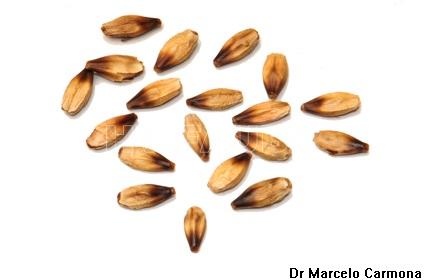
El extremo del embrión en la semilla de cebada se presenta pardo oscuro a negro.
.
Daños
Puede disminuir el poder germinativo y afectar la calidad maltera.
.
Epidemiología y factores de riesgo
La enfermedad es dependiente del ambiente. Generalmente está asociada con condiciones elevadas de temperatura y humedad, acompañadas con lluvias al final del ciclo. Es más frecuente en la zona norte de la Región Pampeana cuando los granos verdes están en formación.
.
Manejo de la enfermedad
Es de difícil manejo. Se busca resistencia genética porque todos los cultivares son susceptibles. El tratamiento de los lotes con semillas enfermas puede mejorar la germinación. Las pulverizaciones foliares no disminuyen significativamente la incidencia de la enfermedad.
.

.
.
Bibliografía
Aboukhaddour R, Hafez Abdel-Fattah M, McDonald M, et al. (2023) A revised nomenclature for ToxA haplotypes across multiple fungal species. Phytopathology. doi: 10.1094/PHYTO-01-23-0017-SC
Aggarwal R, Agarwal S, Sharma S, et al. (2022) Whole-genome sequence analysis of Bipolaris sorokiniana infecting wheat in India and characterization of ToxA gene in different isolates as pathogenicity determinants. 3 Biotech. 12(7): 151. doi: 10.1007/s13205-022-03213-3
Agostinetto L, Trezzi Casa R, Bogo A, et al. (2015) Barley spot blotch intensity, damage, and control response to foliar fungicide application in southern Brazil. Crop Protection 67: 7-12. doi: 10.1016/j.cropro.2014.09.012
Al-Sadi AM (2021) Bipolaris sorokiniana-Induced Black Point, Common Root Rot, and Spot Blotch Diseases of Wheat: A Review. Front. Cell. Infect. Microbiol. 11: 584899. doi: 10.3389/fcimb.2021.584899
, , , et al. (2025) Recent Advances in Spot Blotch of Barley and Its Future Perspectives. Plant Pathology 1–19. doi: 10.1111/ppa.70057
Bucknell A, Wilson HM, Gonçalves dos Santos KC, et al. (2025) Sanctuary: a Starship transposon facilitating the movement of the virulence factor ToxA in fungal wheat pathogens. mBio0: e01371-25. doi: 10.1128/mbio.01371-25
MA (2021) Sensitivity of Bipolaris sorokiniana to strobilurin, triazole, and carboxamide premixes. Archives of Phytopathology and Plant Protection 54: 1764-1777. doi: 10.1080/03235408.2021.1938920
Duczek LJ, Sutherland KA, Reed SL, et al. (1999) Survival of leaf spot pathogens on crop residues of wheat and barley in Saskatchewan. Canadian Journal of Plant Pathology 21: 165-173. doi: 10.1080/07060669909501208
Dutbayev Y, Kuldybayev N, Daugaliyeva S, et al. (2022) Occurrence of Spot Blotch in Spring Barley Caused by Bipolaris sorokiniana Shoem. in South-Eastern Kazakhstan. Scientific World Journal. 2022: 3602996. doi: 10.1155/2022/3602996
Fan J, Hu J, Li D, et al. (2025) Two Subunits of the Rpd3 Histone Deacetylase Complex of Cochliobolus heterostrophus Are Essential for Nitrosative Stress Response and Virulence, and Interact With Stress-Response Regulators ChHog1 and ChCrz1. Molecular Plant Pathology 26: e70131. doi: 10.1111/mpp.70131
Friesen TL, Faris JD, Solomon PS, Oliver RP (2008) Host-specific toxins: effectors of necrotrophic pathogenicity. Cell Microbiol. 10(7): 1421-8. doi: 10.1111/j.1462-5822.2008.01153.x
Holz TM, Dorneles KR, Brunetto AE (2022) Effect of silicon and fungicide on photosynthetic responses in barley leaves challenged by Bipolaris sorokiniana. Physiological and Molecular Plant Pathology 120: 101849. doi: 10.1016/j.pmpp.2022.101849
Hückelhoven R, Kogel K-H (1998) Tissue-specific superoxide generation at interaction sites in resistant and susceptible near-isogenic barley lines attacked by the powdery mildew fungus (Erysiphe graminis f. sp. hordei). Mol. Plant–Microbe Interact. 11: 292–300. doi: 10.1094/MPMI.1998.11.4.292
Jones DG, Clifford BC (1983) Cereal diseases, their pathology and control. John Wiley & Sons Ltd.
Kervinen T, Peltonen S, Teeri TH, Karjalainen R (1998) Differential expression of phenylalanine ammonia-lyase genes in barley induced by fungal infection or elicitors. New Phytologist 139: 293-300. doi: 10.1046/j.1469-8137.1998.00202.x
Kumar J, Hückelhoven R, Beckhove U, et al. (2001) A compromised Mlo pathway affects the response of barley to the necrotrophic fungus Bipolaris sorokiniana (teleomorph: Cochliobolus sativus). Phytopathology 91: 127–133. doi: 10.1094/PHYTO.2001.91.2.127
Kumar J, Schäfer P, Hückelhoven R, et al. (2002) Bipolaris sorokiniana, a cereal pathogen of global concern: cytological and molecular approaches towards better control. Molecular Plant Pathology 3: 185-195. doi: 10.1046/j.1364-3703.2002.00120.x
Leng Y, Zhong S (2015) The Role of Mitogen-Activated Protein (MAP) Kinase Signaling Components in the Fungal Development, Stress Response and Virulence of the Fungal Cereal Pathogen Bipolaris sorokiniana. PLoS ONE 10(5): e0128291. doi: 10.1371/journal.pone.0128291
Manamgoda DS, Rossman AY, Castlebury LA, et al. (2014) The genus Bipolaris. Studies in Mycology 79: 221-288. doi: 10.1016/j.simyco.2014.10.002
Matusinsky P, Frei P, Mikolasova R, et al. (2010) Species-specific detection of Bipolaris sorokiniana from wheat and barley tissues. Crop Protection 29(11): 1325-1330. doi: 10.1016/j.cropro.2010.07.013
McDonald MC, Ahren D, Simpfendorfer S, et al. (2017) The discovery of the virulence gene ToxA in the wheat and barley pathogen Bipolaris sorokiniana. Molecular Plant Pathology (in press). doi: 10.1111/mpp.12535
Murray TD, Parry DW, Cattlin ND (1998) A color handbook of diseases of small grain cereal crops. Iowa State University Press, Ames, Iowa.
Reis EM, Zanatta T, Danelli AD (2014) Effect of the concentration of inoculum and tensoactive on the efficiency of Bipolaris sorokiniana infection in wheat leaves. Summa Phytopathologica 40(2): 178-181, 2014. doi: 10.1590/0100-5405/1869
Rohringer R, Kim WK, Samborski DJ, Howes NK (1977) Calcofluor: An optical brightener for fluorescence microscopy of fungal parasites in leaves. Phytopathology 67: 808–810. doi: 10.1094/Phyto-67-808
Sharma S, Sahu R, Navathe S, et al. (2018) Natural Variation in Elicitation of Defense-Signaling Associates to Field Resistance Against the Spot Blotch Disease in Bread Wheat (Triticum aestivum L.). Frontiers in Plant Science 9:636. doi: 10.3389/fpls.2018.00636
, , (2025) Comprehensive Genomic Analysis of Bipolaris sorokiniana Strains: Insights Into Genetic Diversity and Pathogenicity. Plant Pathology 1–20. doi: 10.1111/ppa.70008
Tan YP, Crous PW, Shivas RG (2016) Eight novel Bipolaris species identified from John L. Alcorn’s collections at the Queensland Plant Pathology Herbarium (BRIP). Mycological Progress 15: 1203. doi: 10.1007/s11557-016-1240-6
Walters DR, Avrova A, Bingham IJ, et al. (2012) Control of foliar diseases in barley: towards an integrated approach. Eur J Plant Pathol 133: 33–73. doi: 10.1007/s10658-012-9948-x
Zhao W, Chi YK, Ye MD, et al. (2021) Development and Application of Recombinase Polymerase Amplification Assay for Detection of Bipolaris sorokiniana. Crop Protection 105619. doi: 10.1016/j.cropro.2021.105619